
Badvert of the month: McDonalds megacarbon burger
It was an awkward start to 2026 for the CEO of McDonalds, Chris Kempczinski, whose video of him eating one of his companies’ biggest burgers went viral for being stilted and cringeworthy. Referring to the burger as ‘product’ and commenting on the sesame seeds on the bun, he seemed unfamiliar with the food his company produces and, ultimately, blamed his mum.
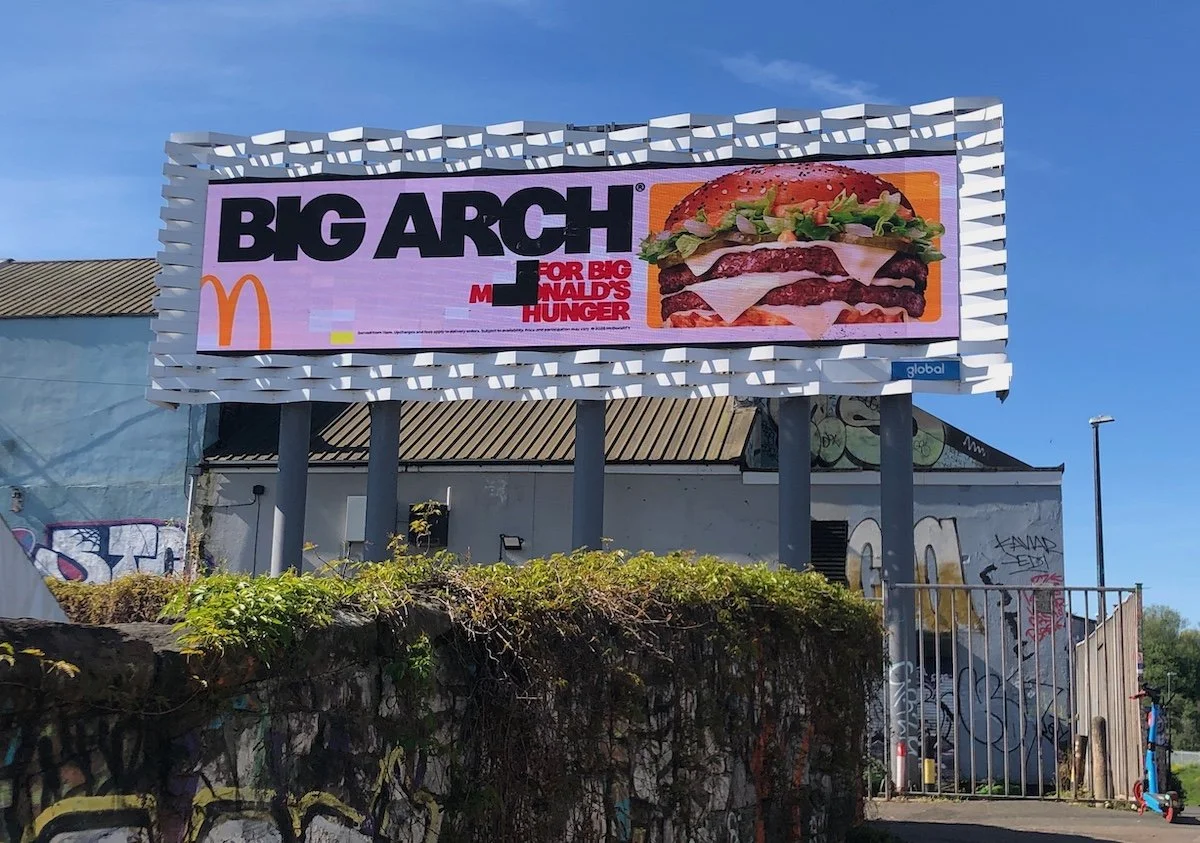
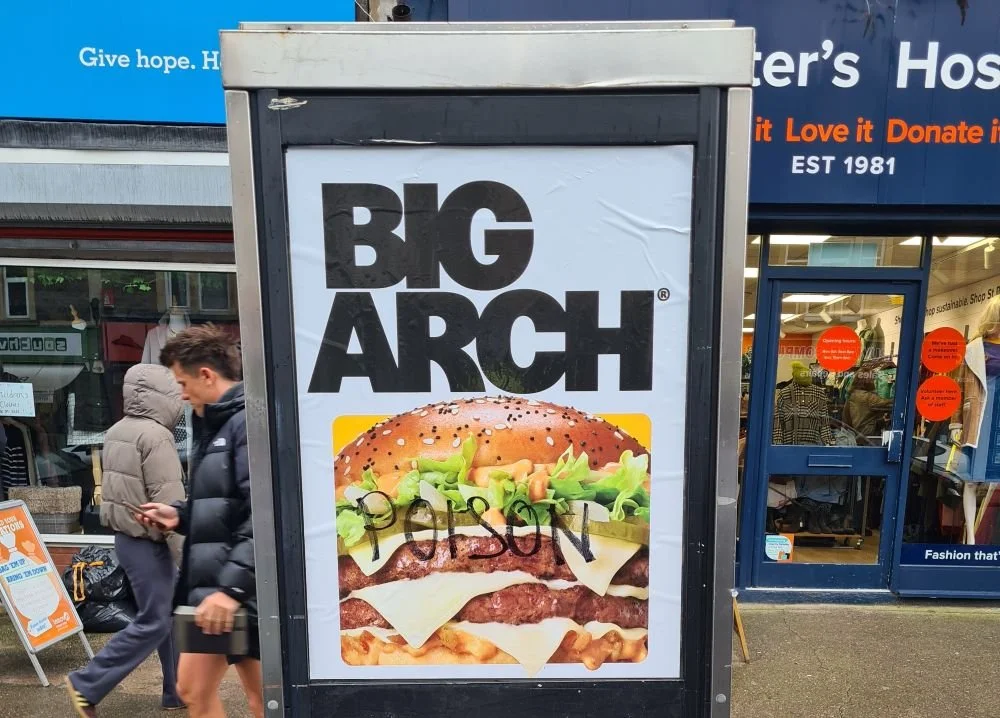
The Big Arch burger hit our consciousness before this viral video, after seeing adverts on billboards promoting it across UK towns and cities. Its sheer size made us question its environmental impact, especially after the inspiring news that Amsterdam has banned meat and fish advertising in public spaces. Amsterdam’s policy aimed to “contribute to health and reduce the negative pressure on the environment and the climate” by supporting a shift towards higher consumption of plant-based proteins.
We calculated that the Big Arch burger emits 19 times the CO2e of a McPlant burger. At a conservative estimate (see calculations below), if you ate one Big Arch burger per episode of The Last of Us (nine episodes) it would equate to the emissions of a flight from London to Paris (42kg CO2e).
Big arch advert, Bristol, credit: Adfree Cities
Advertising encourages consumption. Advertising for beef products encourages the consumption of beef. Beef is by far the most environmentally polluting food type per kg, responsible for more carbon emissions than any other food. As climate and health experts urge the government to support farmers and consumers to shift towards more plant based food, this giant burger advert is pushing in the wrong direction.
We are advocating for the UK government to introduce restrictions on advertising and sponsorship for the most polluting products and services, just as we ended tobacco marketing when we knew the harms caused by smoking.
Agriculture is one of the biggest contributors to climate breakdown and environmental pollution - but it can be controversial to introduce policies to adapt what we eat. Advertising restrictions can help to shift social norms towards healthier and more climate-friendly diets, supporting policymaking alongside public subsidies to ensure plant-based food is affordable, and do so without restricting the actual availability of other products.
What about the ASA?
The UK advertising regulator, the Advertising Standards Authority (ASA) has limited powers to prevent advertising’s growing climate harms. The ASA can only act if adverts make misleading environmental claims, i.e. greenwash. The regulator can’t ban an advert for a flight, fossil fuel company or diesel SUV on the grounds that the advert is promoting something that is intensely high carbon.
But the ASA does have one other principle that we thought might cover adverts like these, which nudge us towards products, diets and ways of living that are particularly carbon intensive.
4.2 Behaviour grossly prejudicial to the protection of the environment
CAP Code 30.7: Advertising must not encourage behaviour grossly prejudicial to the protection of the environment.
BCAP Code 4.12: Advertisements must not condone or encourage behaviour grossly prejudicial to the protection of the environment.
We reported this advert to the ASA on the grounds that it condoned and encouraged behaviour grossly prejudicial to the protection of the environment. The ASA did not take our complaint forward, however, saying:
“We do not currently consider that there is anything within the content of these ads - which show the burger, list its name, and then make a claim about its availability – that suggests they were not prepared with due sense of responsibility to consumers or to society. This is because rule 1.3 applies to the content of ads and is not considered, in isolation, to the product itself being advertised and its environmental impact.”
The UK’s advertising regulator is unable and unwilling to act on advertising’s climate harms (read more in our report: Toothless), and, when asked about its role in restricting fossil fuel advertising the regulator said it “has no official position on a ban and that it is for Parliament to decide”.
In the absence of government action, a surge of local councils across Scotland, England and Wales are introducing Low Carbon Advertising Policies to protect health and the environment. No councils have yet restricted meat advertising - could yours be the first?
Notes
Big Arch environmental impacts
The Big Arch contains 1057 calories and is made up of two 1/4 lb (4oz) 100% beef patties. It is McDonald’s “biggest burger ever”, almost double the size of a Big Mac. As well as beef, the Big Arch has three slices of cheese.
A Big Mac, which is 580 calories and has two smaller (1.6oz) beef patties and one slice of cheese, leads to the emission of 2.35kg of CO2e. It can be assumed that the polluting carbon emissions of the Big Arch are at least double that of a Big Mac.
In comparison, McDonald's McPlant burger emits approximately 0.12-0.29kg CO2e. At a conservative estimate, the Big Arch emits 19 times the CO2e of a McPlant burger.
For the comparison with a flight from London to Paris, we used the Flight Carbon Calculator: https://flightcalculator.conservation.org/