Portsmouth Council to restrict adverts for fossil fuels, petrol-diesel cars and single use plastics

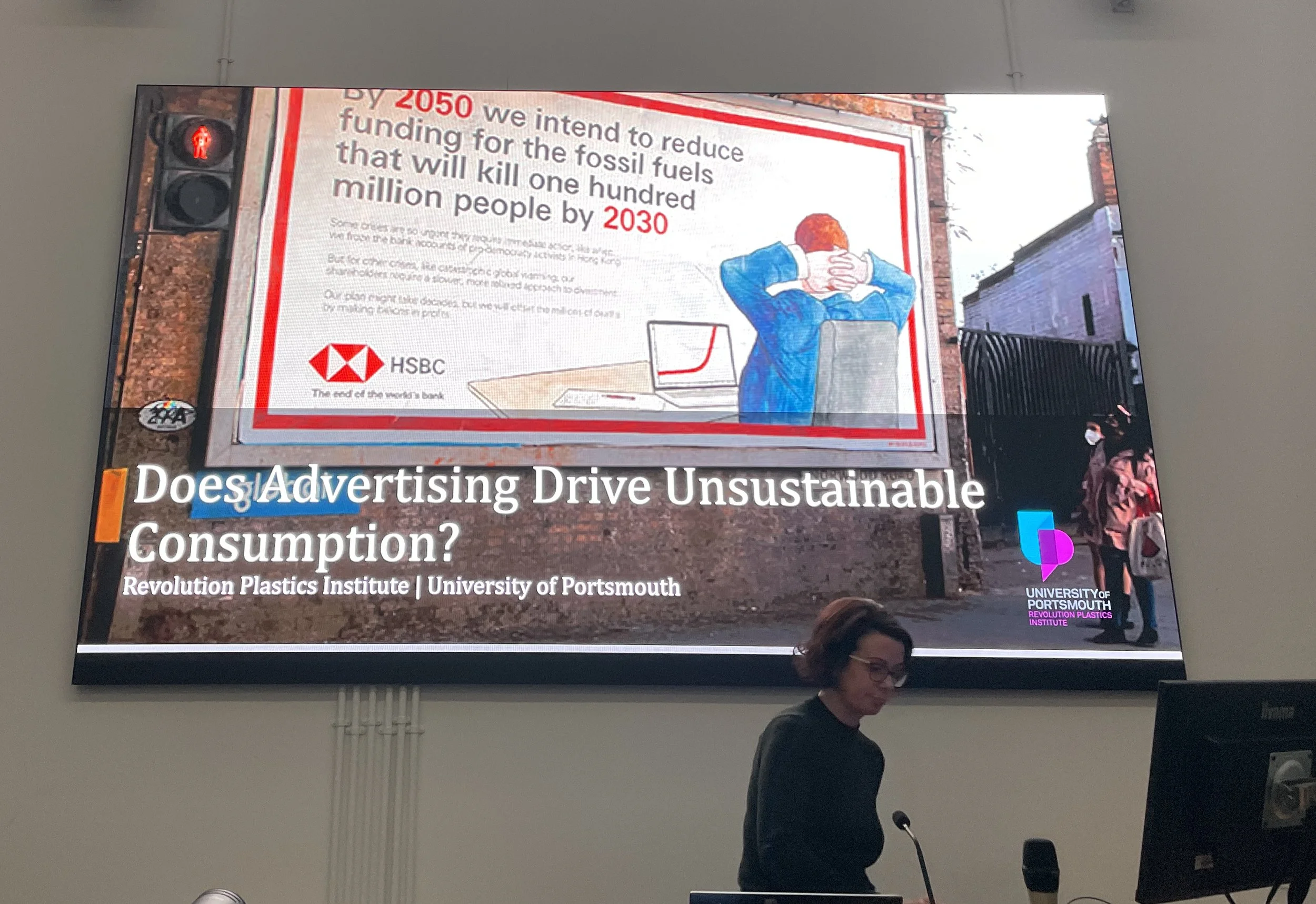
Ahead of Portsmouth Council’s decision, campaigners and academics discuss policy measures to end advertising for harmful products at a University of Portsmouth event in October 2025
Portsmouth is the first UK council to ban advertising for single use plastics.
New policy ends the promotion of fossil fuels, non-electric cars and unhealthy food on council-owned ad sites, in move to protect health and the environment.
When ad sites are oversubscribed, Portsmouth Council said it will prioritise “positive advertising that aligns with council priorities”.
Press release, 13th February 2026, contact Robbie Gillett +447934 591 267 robbie [at] adfreecities.org.uk
Portsmouth City Council has become the latest local authority to restrict advertising for fossil fuel companies, petrol and diesel cars, junk food and single-use plastics in a move to bolster public health and protect the environment. In a cabinet meeting on 10th February 2026, councillors approved the changes which will prohibit advertising for polluting and unhealthy products on council-controlled property. The council also will not permit sponsorship of council projects or events by non-electric car or fossil fuel companies, or sponsorships that promote single use plastics.
The council also said it would prioritise “positive advertising that aligns with council priorities” when ad spaces were oversubscribed, and included measures to support local economic development such as the right to decline advertising for attractions or hotels outside of Portsmouth.
Campaigners hope this will support the council’s climate and health goals, and help to reduce local air pollution. Robbie Gillett from Adfree Cities, an organisation which campaigns to reduce the harms of corporate advertising said,
“Portsmouth is the latest council to strengthen its public health, clean air and environmental goals with this new advertising and sponsorship policy. The power of marketing in shaping our behaviours, our purchases and even our values and aspirations is too often overlooked. Just as we banned adverts for tobacco when we realised the harm caused by smoking, it’s welcome to see local restrictions on adverts for harmful and polluting products.”
Councils are increasingly taking action to end advertising that promotes companies that harm the environment. Portsmouth joins Edinburgh and Sheffield, which have both put an end to advertising for polluting companies like fossil fuels, saying that such ads are incompatible with the councils’ net zero goals. Portsmouth Council is the first in the UK to end the promotion of single use plastics.
Dr Kate Whitman, advertising researcher at the Revolution Plastics Institute, University of Portsmouth, said:
“There is strong evidence that advertising drives overconsumption and waste. As a Portsmouth-based research institute dedicated to reducing plastic pollution, we wholeheartedly support the council’s decision to end the promotion of single-use plastics. We hope more councils will follow suit, and that measures like this will encourage brands to move towards circular packaging systems, such as reuse and refill models, which can deliver significant environmental benefits.”
Portsmouth’s Green Party welcomed the policy but called on Portsmouth Council to go further. Lizzie Rose, Portsmouth Green Party's Young Greens Officer said,
“This is amazing news for Portsmouth residents. Portsmouth Green Party has been campaigning to ban harmful ads in our city for over a year, to protect public health and our planet, and it is encouraging to see the Council being receptive to local concerns and the evidence against advertising's detrimental impacts. We are especially glad to see a ban on fast food, fossil fuel and single use plastic advertising. However, given that over 12 million people pass through Portsmouth every year, and each one is exposed to hundreds, if not thousands, of adverts during their time in the city, we would still like to see an even stronger policy that prevents exposure to ads promoting harmful and polluting industries like airlines and SUVs. Better yet, we’d rather see art and nature, not ads, in our public spaces.”
Councils in the UK including Edinburgh, Sheffield, Cambridgeshire, Devon and Hackney have all joined international cities such as Amsterdam, Stockholm, Sydney and Florence in restricting advertising for environmentally-harmful companies and products.
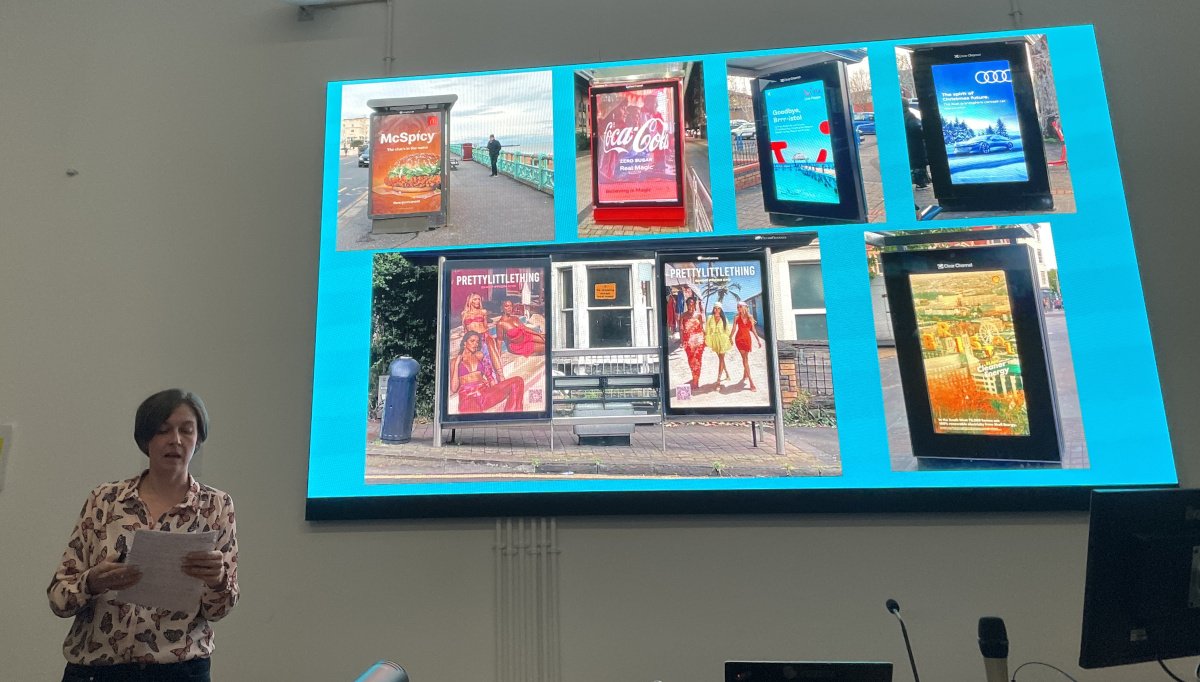
Nicola Wilks from Adfree Cities discusses advertising bans at a University of Portsmouth event in October 2025
Advertising restrictions have proven public health and economic benefits. For example, controls on tobacco advertising have prevented smoking uptake and illness. Removing adverts for unhealthy food across the Transport for London (TfL) network lowered purchasing of unhealthy food and is estimated to lead to £218 million in savings for the NHS and social services.
Local anti-plastics campaigner Clare Seek, said: "It’s great to see Portsmouth continuing to work to eliminate single-use plastic after gaining Surfers Against Sewage Plastic Free City status a couple of years ago. We all know that advertising impacts buying choices, so this is a positive move, alongside the other restrictions inline with our city’s priorities for the planet and our citizen’s health."
ENDS
Notes to Editors
Policy documents:
Portsmouth City Council’s Updated Advertising & Sponsorship Policy, adopted 10th February 2026: https://democracy.portsmouth.gov.uk/documents/s61465/Appendix%20A%20-%20Advertising%20and%20Sponsorship%20Policy.pdf
Portsmouth Council Cabinet Agenda item, with background information on the updated Advertising & Sponsorship Policy https://democracy.portsmouth.gov.uk/documents/s61464/Advertising%20and%20Sponsorship%20Policy%20update.pdf
Extract from Portsmouth City Council’s Updated Advertising & Sponsorship Policy, adopted 10th Feb 2026 (Section 5. Advertising Policy):
“Content that is not permitted includes, but is not limited to, advertising that contains, suggests or infers, in either written or pictorial form, any of the following:
content disparaging or promoting a person/group of people on the grounds of race, religion or any other protected characteristic
content expressing a political view
content promoting tobacco products or tobacco
content promoting weapons
content promoting fossil fuel companies
content promoting petrol or diesel vehicles
content explicitly promoting single-use plastics
content promoting alcohol
content promoting 'junk food' or less healthy food or drink
content promoting gambling (except where profits go to charity/voluntary and community sector organisations/social enterprises)
content promoting financial products and services with exploitative interest rates, for example payday loans/lenders
content promoting/inciting illegal, violent or anti-social behaviours
content that could be construed as promoting services of a sexual nature”